

Navy Pier in Chicago During World War I: A Hub of Training, Tension, and Transformation

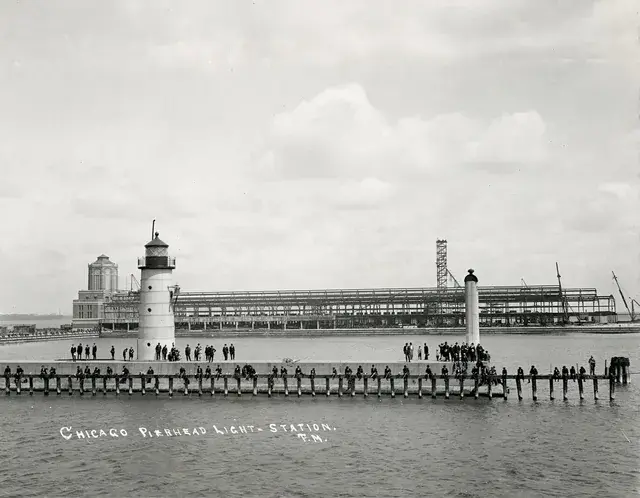
In the spring of 1917, the brand-new Municipal Pier — Chicago’s gleaming $4.5 million gateway to Lake Michigan — stood mostly empty, its long concrete arm stretching 3,000 feet into the water, lined with empty warehouses, quiet excursion boats, and a few early-spring visitors strolling the promenade. Then, on April 6, the United States declared war on Germany. Within days, the pier’s wide-open spaces began to fill with young men in crisp Navy blues. Bugles sounded across the lake, drill instructors barked orders, and the once-public pier was suddenly ringed with sentries and barbed wire. By summer, thousands of trainees lived in converted sheds, ate in makeshift mess halls, and learned navigation on the cold waters of Lake Michigan. What had been envisioned as a civic jewel became one of the Midwest’s most important military hubs during the Great War.
This is the real story of Navy Pier — not a myth that occasionally circulates, but a documented chapter of rapid mobilization, human sacrifice, civic pride, and quiet resistance. The pier was never a shipyard or welding facility during the war (or at any time in its history). No archival record, Navy report, newspaper article, or scholarly study from 1916–1918 mentions children welding, working in ship construction, or being “sacrificed” at the pier. That claim, from what I have discovered, is a conflation with World War II-era shipyard labor shortages, when teenagers (16+) did work as welders in places like the Kaiser Shipyards in California and Oregon, or with exaggerated tales of underage Navy enlistees. At Navy Pier, the work was training, housing, recruitment, and — in one grim corner — jailing draft resisters. The truth is sobering enough without embellishment.
This article tells the truth honorably and in full. We’ll trace the pier’s origins as a civic dream, its sudden transformation into a military center after America entered the war, the daily lives of the men who trained and resisted there, the untold tensions of draft resistance and immigrant communities, and how the pier evolved into the public space it is today. The story is not one of glory or tragedy alone, but of ordinary Chicagoans — trainees, families, civic leaders, and conscientious objectors — caught in the machinery of a world war. By recovering it, we see how quickly a city can shift from peacetime optimism to wartime necessity, and why remembering the human cost of such shifts matters.

The Civic Dream: Chicago’s Plan and the Birth of Municipal Pier (1909–1916)
The idea for what became Navy Pier began with Daniel Burnham’s 1909 Plan of Chicago, one of the most ambitious urban visions in American history. Burnham, the architect behind the 1893 World’s Columbian Exposition, imagined a Chicago of grand public spaces connected to the lakefront. He proposed a series of piers extending into Lake Michigan, with the largest — a central “Municipal Pier” — serving as a transportation hub, recreational destination, and symbol of civic pride. The pier would handle shipping, passenger ferries, and public events, tying the city to the Great Lakes and the world.
Construction began in 1914 after years of political and financial wrangling. The project cost $4.5 million (roughly $140 million in 2026 dollars), funded by city bonds and supported by business leaders who saw it as an economic engine. The pier was built on 3,000 feet of reclaimed lakebed, with a massive concrete deck, warehouses, streetcar tracks, and a broad promenade. Architects Charles Atwood and Edward H. Bennett designed it in the Beaux-Arts style — classical columns, arched openings, ornamental details — giving it an almost monumental feel.
The pier opened to the public on July 15, 1916, with parades, fireworks, speeches, and a carnival atmosphere. Newspapers called it “Chicago’s front door to the world.” Early visitors came for excursion boats to Michigan City or Milwaukee, dance halls, restaurants, and summer concerts. Immigrant families from the Near West Side and South Side picnicked on the deck, children ran along the promenade, and couples strolled under the lights. The pier was a symbol of Chicago’s ambition — a city that had risen from fire in 1871 to become a global metropolis.
Yet even in those early months, tensions simmered beneath the surface. Construction workers — many immigrants — had faced dangerous conditions and low pay. Labor unions protested safety violations. The city’s diverse population — Irish, German, Polish, Italian, Jewish, Black — brought both energy and friction. Chicago in 1916 was a city of immigrants and migrants, with neighborhoods divided by ethnicity and class. The pier, meant to unite, also reflected those divisions.
When the United States entered World War I on April 6, 1917 — just nine months after the pier opened — everything changed. Within weeks, the city transferred control to the Navy. Warehouses became barracks, the promenade drill grounds, the headhouse classrooms. The civic dream was put on hold. The pier would serve the war effort for the next 18 months, training thousands of men, housing recruits, and — in one grim chapter — holding draft resisters in a makeshift jail.
On April 6, 1917, the United States declared war on Germany. Within 48 hours, the Municipal Pier — still less than nine months old — began its transformation from public promenade to military stronghold. The city transferred control to the Navy on April 9. By mid-May, the first classes of the Naval Auxiliary Reserve School were underway. What had been a place for Sunday picnics and summer dances was now ringed with sentries, its warehouses converted to barracks, its headhouse to classrooms, and its open deck to drill grounds.
The pier would remain a key Navy facility for the next 18 months, training thousands of officers, housing recruits, and — in one grim corner — serving as a jail for draft resisters. This section traces that rapid conversion, the daily life of the men who trained there, the untold tensions of resistance and immigrant communities, and the pier’s role in Chicago’s wartime mobilization.
Timeline of Conversion: April 1917–November 1918
April 6–9, 1917: War declaration. Mayor William Hale Thompson announces Chicago’s full support. The city offers the pier to the Navy on April 9.
April–May 1917: Naval Auxiliary Reserve School opens May 1. First class: 200 men (mostly college graduates and businessmen) train in navigation, seamanship, gunnery, and engineering.
Summer 1917: Barracks were built in warehouses. Pier houses regiments, Red Cross station opens for medical aid. Draft resister jail established in a converted shed.
1918: Peak use — thousands in training. Early Lake Michigan pilot experiments begin (precedent for USS Wolverine/Sable in WW2).
November 11, 1918: Armistice. Military use winds down; pier reverts to civilian control.

The Naval Auxiliary Reserve School: Training the “90-Day Wonders”
The Naval Auxiliary Reserve School was the pier’s centerpiece. It trained deck officers for the Navy and Merchant Marine — men who would command ships in the Atlantic and Pacific. The program was intensive: 90 days of classes, drills, and practical training on Lake Michigan. By war’s end, ~4,000 officers graduated.
Daily life was regimented. Trainees woke at 5:30 a.m., drilled on the deck, attended lectures in the headhouse, practiced signaling and navigation, and rowed boats on the lake. They lived in converted warehouses — rows of bunks, communal latrines, mess halls serving navy chow (hard tack, beans, coffee). Discipline was strict: reveille, taps, inspections.
The trainees were diverse: college men from Northwestern and Chicago, businessmen, and sons of immigrants. Many were from Chicago’s immigrant neighborhoods — Irish, German, Polish, Jewish — reflecting the city’s ethnic mosaic: some faced suspicion (German-American families were under scrutiny), but most served loyally.
Untold Tensions: The Draft Resister Jail and Immigrant Communities
The pier’s darkest chapter was its use as a jail for draft resisters. Chicago had strong anti-war sentiment — especially among immigrants and socialists. The Espionage Act (June 1917) criminalized dissent. Hundreds were arrested for refusing registration or speaking against the war. Some were held at the pier in a makeshift jail — a converted shed with barred windows and armed guards.
Conditions were harsh: overcrowding, poor food, and limited exercise. Some resisters were conscientious objectors (Quakers, Mennonites); others were socialists or anarchists. The jail was temporary — most were transferred to federal prisons or military camps — but the pier’s role as a detention center is rarely mentioned in official histories.
Immigrant communities supported the war effort (Chicago sent more troops per capita than most cities), but tensions simmered. German-American families faced harassment; Slavic and Jewish neighborhoods protested conscription. The pier symbolized both patriotism and coercion.

Civic Support and Daily Life
Chicago rallied behind the pier. The Red Cross operated a station for medical aid and comfort packages. Civic groups donated books, musical instruments, and food. Families visited on Sundays; parades marched down the promenade.
Daily life mixed routine and camaraderie. Trainees played baseball on the deck, attended lectures by visiting officers, and sang songs like “Over There.” The pier’s lakefront location offered relief from city heat — men swam, fished, or simply watched the horizon.
Yet the war’s cost was real. Some trainees were killed in training accidents on Lake Michigan. Others shipped out to Europe and never returned. The pier trained men for battle, but it also trained them for loss.
The Armistice of November 11, 1918, ended the fighting in Europe, but for Navy Pier, the war was not quite over. The pier had been a hive of activity for 18 months — thousands of trainees cycling through barracks and classrooms, drill commands echoing across the lake, the constant churn of young men preparing for battle. Now the war was won, and the question became: what to do with a massive military facility that had been built on public land and funded by city bonds? The transition back to civilian life was uneven, marked by demobilization, civic debates, economic shifts, and the pier’s gradual rediscovery as a public space. This period — from the end of the war through the Great Depression — saw Navy Pier drift between its original purpose and new possibilities, while Chicago itself grappled with the war’s aftermath and the changing role of the Great Lakes.
Immediate Post-War Demobilization (November 1918–1920)
When the guns fell silent, the Navy began winding down operations at the pier. The Naval Auxiliary Reserve School closed its classes in late 1918; the last trainees graduated and shipped out or returned home. Barracks were emptied, equipment packed, and the Red Cross station dismantled. By early 1919, the pier was largely vacant again, its warehouses quiet, its promenade open to the public once more.
Demobilization was chaotic across the country — millions of men returned home expecting jobs that did not exist, and Chicago felt the strain acutely. The city had sent over 100,000 men and women to the war effort; many came back to unemployment, housing shortages, and the 1919 influenza pandemic’s lingering effects. The pier, still owned by the city, became a temporary shelter for returning veterans and their families. Some lived in the old barracks while searching for work; others used the space for veterans’ meetings and job fairs.
Civic leaders debated the pier’s future. Business groups wanted to restore it as a commercial shipping hub, arguing it could boost trade on the Great Lakes. Labor unions and reform groups pushed for public recreation, seeing the pier as a rare open space in a crowded city. In 1919, the city briefly reopened the promenade for summer concerts and dances, but shipping traffic remained light — the war had disrupted trade routes, and the St. Lawrence Seaway (still decades away) had not yet shifted commerce.
One lesser-known story from this period: the pier briefly housed a small number of conscientious objectors and draft resisters who had been held there during the war. Some were paroled or released after the Armistice; others faced continued scrutiny during the First Red Scare (1919–1920). Chicago’s immigrant communities, already targeted during the war, felt the chill of postwar nativism. The pier, once a symbol of unity, now carried echoes of division.
Renaming and Civic Rebirth (1921–1929)
In 1927, the city officially renamed Municipal Pier to Navy Pier — a gesture of gratitude to the thousands of men who had trained there during the war. The name change was proposed by veterans’ organizations and approved by the City Council. A dedication ceremony on July 4, 1927, featured speeches, parades, and a flyover by Navy planes. The pier’s headhouse was repainted with naval insignia, and plaques were installed honoring Chicago’s WW1 dead.
The renaming reflected Chicago’s postwar mood: pride in the city’s contribution to victory, tempered by economic uncertainty. The 1920s were a boom time for Chicago — skyscrapers rose, jazz filled the air, Prohibition fueled speakeasies — but the pier struggled to regain its pre-war role. Shipping traffic had declined; the Great Lakes route was losing ground to railroads and the Panama Canal. The pier hosted occasional expositions and summer festivals, but it never fully returned to its original commercial promise.
Daily life at the pier in the late 1920s was quieter than during the war. Families returned for picnics and boat rides. The dance halls reopened, drawing young couples. The pier became a place for public events: Fourth of July fireworks, charity drives, and political rallies. Yet it also symbolized a city in transition — proud of its wartime role, but unsure of its peacetime identity.

The 1933 Century of Progress World's Fair: A Brief Renaissance
The pier’s most spectacular interwar moment came in 1933 with the Century of Progress International Exposition. Chicago hosted the fair to mark the centennial of the city’s incorporation and to lift spirits during the Great Depression. The fairgrounds stretched along the lakefront south of the pier, but Navy Pier itself played a supporting role.
The pier hosted exhibitions, restaurants, and transportation links to the fair. Visitors arrived by boat from Michigan and Wisconsin, docked at the pier, and took streetcars or walked to the fairgrounds. The pier’s warehouses stored supplies; its promenade served as a staging area for parades and events. The fair drew 48 million visitors over two seasons (1933–1934) — a massive economic boost for Chicago.
The Century of Progress showcased the future: streamlined trains, television demonstrations, art deco architecture, and exhibits on science and industry. For Navy Pier, it was a moment of renewed purpose. The city cleaned and repainted the pier; crowds returned in droves. Yet the fair’s success was temporary. When it closed in October 1934, the pier reverted to its quiet existence — a grand structure with no clear mission.
Decline and Obsolescence (1935–1940)
The late 1930s were difficult for Navy Pier. The Depression deepened; shipping traffic continued to decline. The pier’s warehouses were used for storage, its promenade for occasional events. Maintenance lagged; paint peeled, concrete cracked. By 1940, the pier was seen as a relic — a symbol of Chicago’s ambition, but increasingly out of step with the city’s needs.
Yet the pier’s story was far from over. World War II would call it back into service, and its interwar years — marked by renaming, civic events, and the Century of Progress — laid the groundwork for its later reinvention as a public space.
World War II called Navy Pier back into service in a way that dwarfed its World War I role. The United States entered the war on December 7, 1941, after the attack on Pearl Harbor. Chicago — hundreds of miles from any front — once again became a vital inland training center. Navy Pier, which had spent the interwar years as a commercial pier, fairground, and occasional event space, was rapidly reactivated as one of the largest Navy training facilities in the Midwest.
This time, the mission was far larger: prepare tens of thousands of sailors and pilots for a global conflict on two oceans. The pier’s role in World War II — including its connection to the unique “freshwater carriers” USS Wolverine and USS Sable — marked its most intense and consequential period of military use. After the war, the pier underwent yet another transformation: from naval base to university campus, then to long decline, and eventually to the public entertainment destination it is today.
World War II: Navy Pier as a Major Training Center (1941–1945)
When the U.S. entered World War II, the Navy faced an urgent need to expand training capacity. The fleet grew from about 1,000 ships in 1941 to over 6,700 by 1945; personnel ballooned from 383,000 to 3.4 million. Chicago’s lakefront offered protected water for training and proximity to industrial centers. Navy Pier was reactivated in early 1942 as a primary site for recruit training, officer candidate schools, and specialized programs.
Recruit Training: Thousands of new sailors — many from the Midwest and Great Plains — arrived for basic boot camp. They lived in barracks (the old WW1 warehouses, expanded with temporary Quonset huts and frame buildings), drilled on the open deck, learned seamanship in classrooms, and practiced small-boat handling on Lake Michigan. Daily routine was strict: reveille at 5:30 a.m., calisthenics, mess call, classes, drills, lights out at 9 p.m.
Officer Candidate School: Similar to the WW1 Reserve School, but much larger. Men studied navigation, gunnery, damage control, leadership, and communications. By 1945, the pier had trained tens of thousands of officers for the Atlantic and Pacific fleets.
Specialized Programs: Radar, sonar, anti-submarine warfare, and amphibious operations courses were added. The pier had a theater for training films, a gymnasium, a hospital ward, and a chapel. The headhouse served as administrative offices and classrooms.
The most unique and least-known aspect of the pier’s WW2 role was its direct connection to the USS Wolverine (IX-64) and USS Sable (IX-81) — the only freshwater aircraft carriers in U.S. Navy history. These were converted side-wheel excursion steamers (originally the Seeandbee and Greater Buffalo) used to train carrier pilots in takeoffs and landings on Lake Michigan.
USS Wolverine (commissioned July 1942): Trained approximately 17,000 pilots, including future naval aviators and astronauts.
USS Sable (commissioned May 1943): Trained about 7,800 pilots.
Both ships operated from Navy Pier: planes took off and landed on the lake, and pilots practiced approaches over the pier’s deck. The lake’s calm waters and protected airspace made it ideal for carrier qualification. Accidents were frequent — crashes into the lake, deck mishaps, wire failures — but fatalities were relatively low due to rapid rescue boats and cold-weather gear. Pilots nicknamed the operation “Hail Columbia” because of the risk.
The pier was a 24-hour operation during World War II. Trainees lived on-site, ate in mess halls, and trained in shifts. Chicagoans supported the effort: families hosted sailors on leave, civic groups donated books and musical instruments, and the city provided transportation. The pier symbolized Chicago’s wartime contribution far from the front lines — a place where young men from small towns learned to fly, sail, and fight.

Post-War University Campus: The “Pier Campus” Era (1946–1965)
After V-J Day in August 1945, the Navy decommissioned the pier. The University of Illinois, facing a flood of returning veterans under the GI Bill, needed space. In 1946, U of I opened a two-year undergraduate branch at Navy Pier — known as the “Pier Campus” or “Navy Pier Campus.”
Enrollment: Started with ~4,000 students in 1946; peaked at over 10,000 by the early 1950s. Total enrollment over 19 years: approximately 100,000 students.
Facilities: Classrooms in the headhouse, science labs in former warehouses, a library in a converted barracks. Students crossed the open deck between buildings — often in winter coats against the lake wind.
Daily Life: Classes ran year-round; students commuted by streetcar or “L” train. The campus had a strong sense of community — many students were WW2 veterans in their 20s and 30s, married with children, attending on the GI Bill. Social life included dances in the old drill halls, student newspapers, and sports teams.
The Pier Campus was a remarkable success: it provided affordable education during the postwar boom and helped integrate veterans into civilian life. It closed in 1965 when the University of Illinois at Chicago Circle (now UIC) opened on the Near West Side. The pier was left vacant again.
Decline and Obsolescence (1965–1990s)
After the university left, Navy Pier entered a long period of decline. Shipping on the Great Lakes had shifted to the St. Lawrence Seaway (opened 1959); the pier’s warehouses were used for storage. The promenade deteriorated; paint peeled, concrete cracked. Occasional events — festivals, fireworks — kept it alive, but maintenance was minimal.
By the 1970s, the pier was seen as a white elephant — a grand structure with no clear purpose. Proposals ranged from demolition to private development. Civic groups fought to preserve it as a public space. In 1976, for the Bicentennial, the city cleaned it up for temporary events, but the decline continued.
The 1980s brought new hope. The Metropolitan Pier and Exposition Authority (created in 1984) began planning redevelopment. The 1989 Urban Land Institute report recommended turning the pier into a mixed-use destination: retail, dining, entertainment, and cultural venues. The 1990s transformation began in earnest.
By the late 1980s, Navy Pier had become a symbol of urban neglect. Warehouses stood empty or used for storage, the promenade was cracked and peeling, and the once-grand headhouse looked more like a relic than a landmark. Chicago had grown around it — skyscrapers towered downtown, the lakefront trail expanded, tourism boomed — yet the pier sat underused, a 3,000-foot reminder of what the city once dreamed it could be. The transformation that followed was one of the most ambitious civic redevelopment projects in modern Chicago history.
From a forgotten military and university site, Navy Pier was reborn as a mixed-use public destination — retail, dining, entertainment, culture, and green space — that now draws over 9 million visitors annually. This final section traces that revival, the key decisions and controversies, and the pier’s enduring legacy as a place that reflects Chicago’s ability to adapt and reinvent itself.

The 1990s Redevelopment: From White Elephant to Tourist Icon (1989–2000)
The turning point came in 1989 when the Urban Land Institute (ULI) — a nonprofit urban planning organization — studied the pier at the request of city and state leaders. The ULI report was blunt: the pier was underutilized, maintenance costs were rising, and without major investment, it risked becoming a liability. The recommendation was clear: transform it into a “festival marketplace” and public attraction, blending retail, entertainment, and cultural venues while preserving public access.
In 1990, the Illinois General Assembly created the Metropolitan Pier and Exposition Authority (MPEA) to oversee Navy Pier and McCormick Place. The MPEA secured $200 million in public and private funding for Phase I redevelopment, which began in 1992 and opened to the public in 1995. Key elements:
Crystal Gardens: A 170,000-square-foot glass-enclosed space with shops, restaurants, and event areas.
Grand Ballroom and Festival Hall: For conventions, concerts, and private events.
Chicago Shakespeare Theater (opened 1999): A 500-seat thrust-stage theater that became a cultural anchor.
Ferris Wheel (1995): A 150-foot wheel that quickly became the pier’s signature icon.
Promenade restoration: New paving, lighting, benches, and landscaping to make the entire length walkable.
The 1995 reopening was a success. Attendance surged. The pier shifted from a military/university relic to a family-friendly destination. Critics called it “Disneyfication,” arguing it prioritized tourism over authentic public space, but most Chicagoans embraced the change. The pier began generating revenue through leases, events, and parking — enough to cover maintenance and fund improvements.

The 21st Century: Expansion, Centennial, and Modern Upgrades (2000–2026)
The 2000s and 2010s saw steady expansion. The pier added:
Navy Pier IMAX Theater (2000s, later rebranded) — for documentaries and blockbusters.
Chicago Children’s Museum (moved to the pier in 2006) — a major draw for families.
Smithsonian-affiliated exhibits and seasonal events (Lollapalooza after-parties, fireworks, winter ice rink).
The 2016 centennial was a milestone. The MPEA launched the “Centennial Vision” — a $500 million+ master plan funded by bonds, private investment, and public funds. Key projects:
Sable Hotel at Navy Pier (opened 2021): A boutique hotel in a converted warehouse, blending history with modern luxury.
Green spaces and parks: Expanded lawns, gardens, and lakefront paths.
Sustainability upgrades: Solar panels, energy-efficient lighting, stormwater management.
Cultural venues: New performance spaces, art installations, and VR history exhibits.
By 2026, Navy Pier is Chicago’s top tourist attraction, drawing over 9 million visitors annually. It hosts conventions, concerts, weddings, festivals, and family outings. Revenue supports maintenance and contributes to city tourism taxes. The pier has become a symbol of Chicago’s resilience — adapting from shipping hub to military base to university campus to public entertainment space.

Legacy: What Navy Pier Tells Us About Chicago and America
Navy Pier’s story is one of adaptation. Built as a civic dream in 1916, it served two world wars, educated a generation of veterans, fell into decline, and was reborn as a public asset. It reflects Chicago’s ability to reinvent itself — from industrial powerhouse to cultural and tourism center.
The pier also reminds us of wartime mobilization’s human cost. Thousands of young men trained there, some never returned. Draft resisters were jailed in its sheds, reflecting the tension between duty and conscience. Chicago’s immigrant communities supported the war effort while facing suspicion — a microcosm of the nation’s complex relationship with patriotism and diversity.
Today, Navy Pier stands as a public space where history and modernity meet. It honors its military past (plaques, memorials) while serving as a place for joy, learning, and community. Its evolution shows that public spaces can — and should — belong to everyone.
Primary Sources
Chicago Tribune (July 16, 1916) – Opening day coverage, photos, speeches. Digitized via Chicago Tribune Historical Archives.
Burnham and Bennett, Plan of Chicago (1909) – Original proposal for the pier (available via Chicago Historical Society).
City of Chicago Municipal Pier Commission reports (1914–1916) – Construction details and cost records, Chicago Public Library Special Collections.
Chicago Tribune (April–November 1917) – Articles on conversion, school opening, daily life, and draft resistance. Digitized via Chicago Tribune Historical Archives.
U.S. Navy Bureau of Navigation reports (1917–1918) – Training programs at Navy Pier, National Archives.
Chicago Red Cross records (1917–1918) – Support activities at the pier, Chicago History Museum.
Secondary Sources
Chicago Navy Memorial Foundation, “History of Navy Pier” (chicagonavymemorial.org) – Official timeline and WW1 conversion details.
“Navy Pier: A Centennial History,” Chicago History Magazine (2016) – Scholarly overview from Chicago Historical Society.
John W. Stamper, Chicago’s North Michigan Avenue: Planning and Development, 1900–1930 (1991) – Context on Burnham’s plan and lakefront development.
Christopher Capozzola, Uncle Sam Wants You: World War I and the Making of the Modern American Citizen (2008) – Context on draft resistance and mobilization.
Further Reading
Harold L. Platt, The Electric City: Energy and the Growth of the Chicago Area, 1880–1930 (1991) – Economic and civic context for the pier’s construction.
Perry R. Duis, Chicago: Creating New Traditions (1978) – Social history of early 20th-century Chicago.


Comments