

Sybil Ludington: The Forgotten Midnight Rider
Updated: Feb 4

In the annals of American history, certain stories rise to legendary status, etched into the collective memory through poems, paintings, and popular retellings. Paul Revere's midnight ride, immortalized by Henry Wadsworth Longfellow's 1860 poem, is one such tale—a lone horseman galloping through the Massachusetts night to warn of British invasion. Yet just two years later, in the spring of 1777, a 16-year-old girl named Sybil Ludington undertook a similar feat, riding twice as far under harsher conditions to rally colonial militia against a British raid on Danbury, Connecticut.
Her story, though equally daring, has faded into obscurity, overshadowed by her male counterparts. Sybil's ride underscores the unsung contributions of women and young people to the cause of independence, reminding us that the Revolution was won not solely by generals and statesmen, but by ordinary individuals who answered the call of duty in extraordinary ways.
This article explores Sybil Ludington's life, the events of her alleged ride, the historical context of 1777, the sources and debates surrounding its accuracy, and the broader implications for how we remember the Revolution. More than a footnote, her legacy—whether fully verified or amplified by family tradition—offers timeless lessons: true preparedness transcends age or gender, quiet resolve can turn the tide of events, and fostering resilience in all members of society remains as vital today as it was in the founding era.
The Early Life of Sybil Ludington
Sybil Ludington was born on April 5, 1761, in Fredericksburg (now Kent), Putnam County, New York, the eldest of twelve children to Colonel Henry Ludington and his wife, Abigail. Henry was a prosperous farmer, mill owner, and veteran of the French and Indian War who had risen to command the 7th Regiment of the Dutchess County Militia by the outbreak of the Revolution. The Ludingtons lived in a strategic area of the Hudson Valley, where control of the river could determine the war's outcome. Their home served as a hub for patriot activity: soldiers were often quartered there, dispatches arrived regularly, and the family was deeply embedded in the resistance network.
Sybil grew up in a household shaped by frontier hardships and wartime tension. As the eldest daughter, she shouldered significant responsibilities—helping with farm chores, caring for younger siblings, and managing the household during her father's absences. Little is known of her formal education, but in an era when most women received limited schooling, she likely absorbed practical lessons in self-reliance, resourcefulness, and civic duty from her father. Henry's militia command required constant vigilance; the family lived with the threat of loyalist raids and British incursions. This environment instilled in Sybil a sense of responsibility far beyond her years, preparing her for the moment that would define her place in history.
The Ludingtons' loyalty to the patriot cause was unwavering. Henry had helped organize resistance in the Hudson Valley early in the war, and his regiment was part of the decentralized militia system that supplemented Washington's Continental Army. In this context, Sybil was not merely a farmer's daughter; she was part of a family on the front lines of the struggle.

The Midnight Ride: A Night of Urgency and Resolve
The events that propelled Sybil into action unfolded on the evening of April 26, 1777. British forces under General William Tryon launched a raid on Danbury, Connecticut—a key supply depot for the Continental Army. Tryon landed 1,800 troops at Westport and marched inland, reaching Danbury by afternoon. They torched warehouses containing thousands of barrels of flour, pork, rum, and other provisions intended for Washington's troops. The flames lit the sky, and word spread quickly through the countryside.
Around 9 p.m., a weary messenger arrived at the Ludington homestead, about 25 miles from Danbury. Colonel Henry Ludington received the grim news: the British were advancing, and the local militia needed to muster immediately to intercept them. Henry could not leave his post; he was coordinating defenses and organizing his regiment. With no other adults available—his sons too young, the household exhausted—Sybil volunteered to ride out and alert the scattered militiamen.
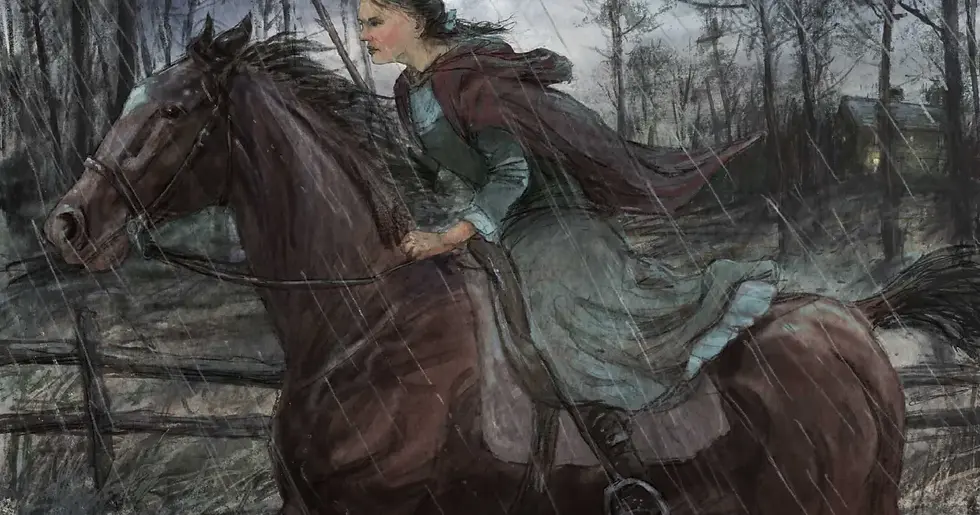
Mounted on her horse (family tradition names it "Star"), Sybil set off into a driving rainstorm. The night was pitch black, the roads muddy and treacherous, winding through forests and over hills in Putnam and Dutchess Counties. She rode approximately 40 miles—twice the distance of Paul Revere's famous journey—knocking on doors, shouting warnings, and urging farmers and tradesmen to grab their muskets and rendezvous at her father's mill. "The British are burning Danbury! Muster at Ludington's!" she called, according to later family accounts. Her path took her through Carmel, Mahopac, and Kent Cliffs, evading potential patrols and navigating by memory in the downpour.
By dawn, Sybil returned home, soaked and exhausted. Her efforts had rallied about 400 men from Henry's regiment. They marched southeast to Ridgefield, Connecticut, where they joined forces under Generals David Wooster and Benedict Arnold (then still a patriot hero) to harass the retreating British. Though the redcoats escaped with minimal losses, the engagement disrupted their plans and boosted colonial morale. Sybil's ride had played a crucial role in mobilizing the response, preventing the raid from becoming a total rout.
Historical Context: The Danbury Raid and the War in 1777
Sybil's exploit occurred at a precarious moment in the Revolution. The year 1777 saw Washington's army reeling from defeats, with British forces aiming to split the colonies by controlling the Hudson Valley. Danbury's destruction was part of this strategy, targeting supplies to weaken patriot resolve. In this light, Sybil's actions were not mere folklore but a tangible contribution to the war effort, embodying the decentralized, volunteer nature of the colonial militia.
The raid itself was a British success in material terms—destroying valuable stores—but the patriot response, including Ludington's regiment, forced a hasty retreat. The engagement at Ridgefield on April 27 cost the British casualties and delayed their plans, contributing to the broader campaign that culminated in the American victory at Saratoga later that year.
Sources, Recognition, and the Debate Over Historical Accuracy
Sybil's story remained largely untold for over a century. The earliest known written account appears in a 1854 letter from her nephew Charles H. Ludington, requesting recognition for her at a Revolutionary heroes ceremony. The first published mention came in Martha J. Lamb's History of the City of New York (1880), based on family records. Benson J. Lossing's Pictorial Field-Book of the Revolution (1851–1852) briefly referenced it, drawing from oral traditions. The most detailed early account is Willis Fletcher Johnson's 1907 memoir of her father, privately published by her grandchildren, which includes family lore of the ride.
No contemporary newspapers, military dispatches, or personal writings from 1777 mention Sybil or the ride explicitly. This absence has led to debate among modern historians. A 2015 article in The New England Quarterly by Paula D. Hunt notes little primary evidence and questions the story's details since at least 1956. Some scholars suggest the tale was amplified in the 20th century for tourism (e.g., 1934 New York historic markers) or to highlight women's contributions. Vincent Dacquino, in his books Sybil Ludington: The Call to Arms (2000) and Patriot Hero of the Hudson Valley (2021), defends the core event using local records, muster rolls, and geography, estimating the 40-mile route based on period maps.
Recognition grew slowly. A bronze statue by Anna Hyatt Huntington was erected in Carmel, New York, in 1961. A U.S. Bicentennial postage stamp in 1975 honored her. Since 1979, the annual Sybil Ludington 50K Run traces her path. These tributes reflect a cultural shift toward acknowledging women's roles, alongside figures like Molly Pitcher and Abigail Adams.
The eclipse of Sybil's story speaks to broader biases: history has often prioritized male exploits amplified by poetry or politics. Revere's ride benefited from Longfellow's 1860 poem. Sybil, a teenage girl from a rural family, lacked such a champion until later generations sought to diversify the pantheon.
Why Forgotten? And the Enduring Contrasts
The underappreciation of Sybil Ludington reveals a pattern in American historiography: the marginalization of women, youth, and non-elites in the founding narrative. The Revolution was not waged solely by elite signers of the Declaration or generals on battlefields; it relied on farmers, artisans, and families like the Ludingtons. Women managed homes, smuggled messages, nursed the wounded, and sometimes took up arms. Sybil's ride exemplifies this, showing that liberty's defense was a collective endeavor, often unglamorous and uncelebrated.
This contrast extends to the ideals of the era. The founders envisioned a republic of virtuous citizens, where equality of opportunity—though imperfectly applied—allowed anyone to rise through merit. Sybil, at 16, embodied this: a young woman stepping into a role typically reserved for men, driven by duty rather than glory. Yet post-Revolution society reinforced gender norms, confining women to domestic spheres and delaying their full citizenship until the 20th century. Her story challenges us to confront these gaps: Why do we elevate some heroes while sidelining others? And how does that shape our understanding of who "belongs" in the American story?
Lessons for Today: Preparedness, Resilience, and Duty
Sybil Ludington's legacy—whether fully verified or amplified by tradition—speaks directly to contemporary America. In an age of uncertainty—natural disasters, economic instability, social divisions—her ride offers practical wisdom. True preparedness is not about stockpiling gear or awaiting catastrophe; it is about cultivating readiness in mind and spirit. Sybil acted with what she had—a horse, knowledge of the land, and resolve.
This is especially relevant for modern families. Threats can emerge suddenly—cyberattacks, supply chain disruptions, community conflicts. Fostering resilience means equipping all members, regardless of age or gender, with skills and confidence. Sybil's example encourages parents to teach children self-reliance, critical thinking, and civic responsibility.
Her story also underscores an unglamorous duty. In an era of viral moments and performative activism, Sybil's ride was private, perilous, and without immediate acclaim. It teaches that real change comes from consistent, behind-the-scenes effort—rallying neighbors or educating oneself on history's hard truths.
By remembering figures like Sybil, we honor the founding principles of liberty and equality, applying them more fully than previous generations could.

Conclusion: Reclaiming the Full American Narrative
There is a commemorative 50-kilometer footrace event in her honor held annually in Carmel, NY, since 1979. Still today, her alleged midnight ride endures as a testament to the Revolution's true character: a people's war, waged by the young, the overlooked, and the resolute. At 16, she covered 40 miles in the dark, rallying hundreds to defend their fledgling nation. Whether the details are exact or embellished, the story's power lies in its reminder that one person's determination can ripple through history.
In reclaiming her narrative, we do more than correct an oversight; we enrich our understanding of America's origins. The founding principles—life, liberty, pursuit of happiness—were forged in such moments of quiet courage. Today, as we navigate uncertainties, Sybil reminds us that preparedness is universal, duty is not glamorous, and resilience begins at home. Every American should know her name—not as a relic, but as a guide: step up when called, and build a nation worthy of all its heroes.
Primary Sources
Benson J. Lossing, The Pictorial Field-Book of the Revolution (1850–1852) – Early mention based on family interviews (Google Books).
Martha J. Lamb, History of the City of New York (1880) – First published account from family records (Archive.org).
Willis Fletcher Johnson, Colonel Henry Ludington: A Memoir (1907) – Family-published details (primary family source).
Secondary Sources
Vincent T. Dacquino, Sybil Ludington: The Call to Arms (2000) & Patriot Hero of the Hudson Valley (2021) – Detailed reconstructions with local records.
Paula D. Hunt, “Sybil Ludington, the Female Paul Revere: The Making of a Revolutionary War Heroine,” New England Quarterly (2015) – Critical analysis of evidence and myth-making.
Abigail Tucker, “Did the Midnight Ride of Sibyl Ludington Ever Happen?” Smithsonian Magazine (2022) – Balanced overview of debates.
Further Reading
Laurel Thatcher Ulrich, Well-Behaved Women Seldom Make History (2007) – On overlooked women's roles.
Carol Berkin, Revolutionary Mothers (2005) – Women's contributions in the Revolution.


Comments